
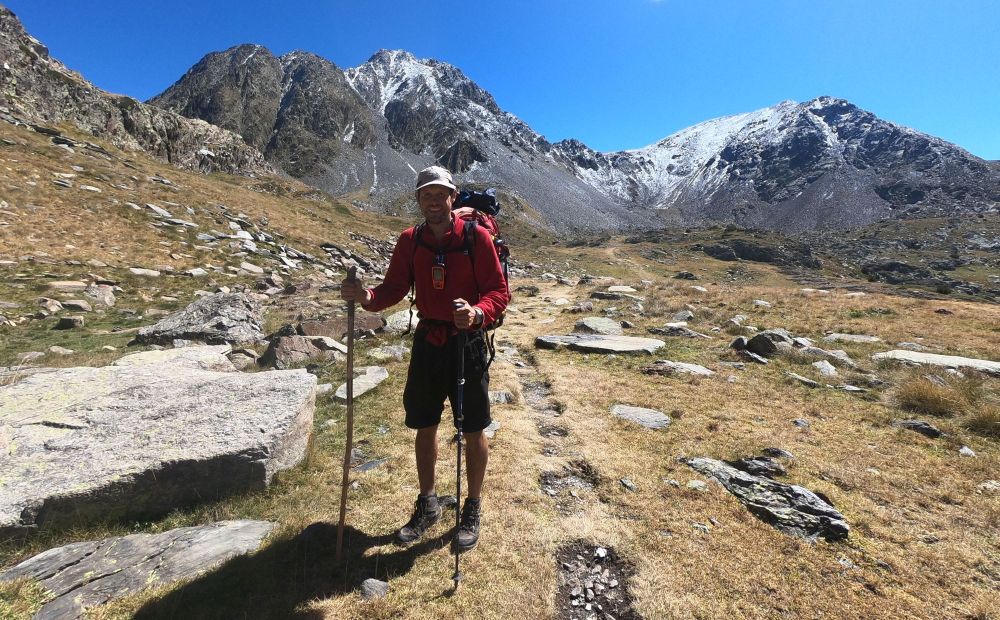
The HRP (Haute Route Pyrénéenne or ARP, Alta Ruta Pirenaica) is high “unmarked” trail between the GR10 (France) and the GR11 (Spain). It crosses the Pyrenees entirely from the Atlantic Ocean to the Mediterranean Sea. There are variants that pass through other peaks, places and Andorra. It is a high mountain trail which is technically more difficult than a GR and requires greater preparation, experience is more demanding.
Every year tens of people try to cross the Pyrenees from one end to the other via the HRP. Many do abandon and sometimes drama occurs with hikers surprised by the sudden bad weather and the elements, storms, lightning... Not everyone finishes the HRP.
I experienced everything the Pyrenees has to offer: beautiful landscapes, animals, storms, wind, rain, heatwave, hunger, thirst, heat, cold, pain and daily fatigu " "I used many bandages" "But also beautiful encounters with shepherds, animals and other hikers, a curious marmot 2 metres away from me, the pleasure of talking because it is my first expedition where I meet many people, it helps my morale but when you talk too much, you don't progress as much ".
Louis-Philippe Loncke filmed himself with a GoPro during the expedition and plans to make a film and give lectures.
Belgian explorer and adventurer Louis-Philippe Loncke (43) has just achieved a world first by becoming the first person in the world to cross the Pyrenees (France, Spain, Andorra) in complete autonomy and without outside assistance.
He set off from Hendaye at the Atlantic Ocean on 16 July with a 49 kg backpack containing all his food and equipment for the crossing. Rules: Never restock, always sleep in his tent, no outside help. He arrived in Banyuls on Sunday and hitchhiked back to Brussels on Monday 7 September.
Nobody has ever succeeded in such a challenge because the difficulty is to carry all his food for the duration of the crossing. He used the HRP as a guideline. He spent 43 days outside because he only slept in a tent.
No resupply, no outside assistance, only sleeping in the tent. This means never sleeping in a refuge. Sleeping under a rock is allowed, taking food (like wild blueberries...) and water found underway. Of course killing a cow or sheep is considered support as from a livestock.
| Types: | Adventure |
|---|---|
| Challenges: | Fully human powered, No food drops, No help from locals, No incoming comms, No preplaced food caches, No repairs / help, No resupplies, Solo |
| Countries: | Andorra, France, Spain |
| Distances: |
estimated: 700,0km |
| Altitudes: | from 0m to 3404m |
First Summit of Pico Aneto, starting from the Sea/Ocean unsupported.
First crossing (hiking) of the Pyrenees unsupported, using the "hard route" of the HRP.
First crossing (hiking) of the Pyrenees unsupported, whatever the "route" never resupplied (only found water in streams, lakes, or wild berries), only sleeping in the tent, avoiding the roads when possible still being on the HRP.
UNICEF
Discount at Trakks and MX3 dehydrated food.
Jason Beaumard for his GPX route.
· The first day he escaped death, he fell into a 5m ravine with his big backpack from an animal trail thinking he was on the HRP during dusk. He is cushioned by brambles and spade plants which like velcro hold him upside down and stop his fall. He escaped with a sprained and bruised ankle.
· He falls rolling over himself in the middle of the expedition and other falls that end without injury.
· The first week is hell because in the heat wave he is very slow and struggles to find water between different points.
· The second week was accompanied by daily thunderstorms with rain, hail and lightning. "Over 7 days I had 6 days of hail, including 1 day with hail at 9am, 2pm and 7pm.
· The dangers of this expedition are the weather and the weight of the backpack. Sleeping only in tents offers freedom but is dangerous if you sleep too high and alone. The weight is so great that you are extremely slow on the climbs and you have to be 100% concentrated on the steep and rocky descents because the fall cannot be stopped and therefore means accident or death. "On the 11th day I have already broken a carbon trekking pole, so I cut down a tree with my small swiss army knife and sharp stones to make a strong walking stick".
· I met people every day. Because of the Covid, it is logical that Europeans have stayed on holiday in Europe and the number of people hiking in the Pyrenees has multiplied this year. I only went into a refuge hut once for 30 minutes to get wifi and send photos, apart from that I stayed outside for 43 days.
· I didn't see any bears or wolves. He saw lots of other animals: insects, lizards, vultures, snakes, marmots, frogs,...
· He was regularly able to find berries (raspberries, blackberries, wild blueberries) in order to find a vitamin supplement.
· He took water from torrents, lakes, rivers, snow, fountains in the few villages he crossed.
· He was not self-sufficient in electricity. He had a solar panel to recharge the batteries but for the record and to power his Garmin tracking GPR in real time, he recharged his big external battery pack. Indeed, his position was put LIVE every 30 minutes on an internet map so that his fans, family and help could locate him. This also proves that he didn't take any transport.
· He took 1 day off, staying 36 hours in tents in Andorra during a series of 3 days of incessant thunderstorms. "The first night was like a Rammstein concert: hail, rain and more than 200 lightning bolts for 11 hours straight. The ground around me became soaked with water".
· I have slept very little in the last few weeks, tired, the noise, the stressed brain unable to stand still, the sound of bells of cows or horse that hangs around their neck, my sharp hearing that hears any suspicious noise".
· The tracking of my GPS track and the daily messages on my Facebook page have been very popular with my fans and the people I met in the Pyrenees.
· His variant of the HRP is 700km including the summit of the Aneto and not the 800km of the original variant of the HRP as he didn’t have to make detours and go down to the villages to resupply.
· He has sometimes walked at night with his headlight, including while being ill in the last 5 days, climbing the Canigou he reached the summit at sunset and had to come back down on the other side in the middle of the night.
· Louis-Philippe did many expeditions with a heavy backpack (+40kgs) and vowed that this would be his last challenge with a heavy backpack in order to preserve his joints. At the age of 43, if he wants to continue the expeditions so he has to start sparing his body.
· During an exceptional cold spell at the end of August, temperatures began to drop sharply. He has always been cold at night, his small worn out down sleeping bag and fat loss not helping. One morning he found his tent at 2100m frozen with a 1mm layer of ice in his tent roof. At 9am in the sun it was still 3°C.
· He had 1.8 kg of food left at the end of the expedition. "We can still kill or hurt ourselves in the last 5kms so we have to ration our food.
| Name | Roles | |
|---|---|---|
|
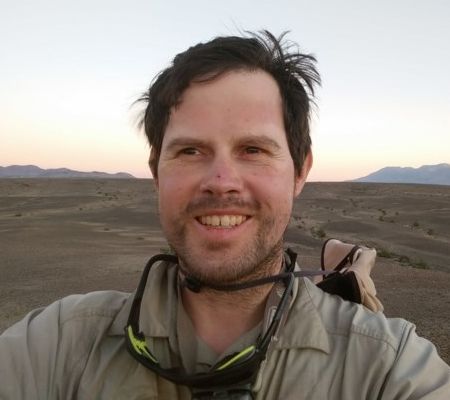
Louis-Philippe Loncke | Expedition leader |